Healthcare Blog
Paper vs Digital Clinic Workflow
Introduction
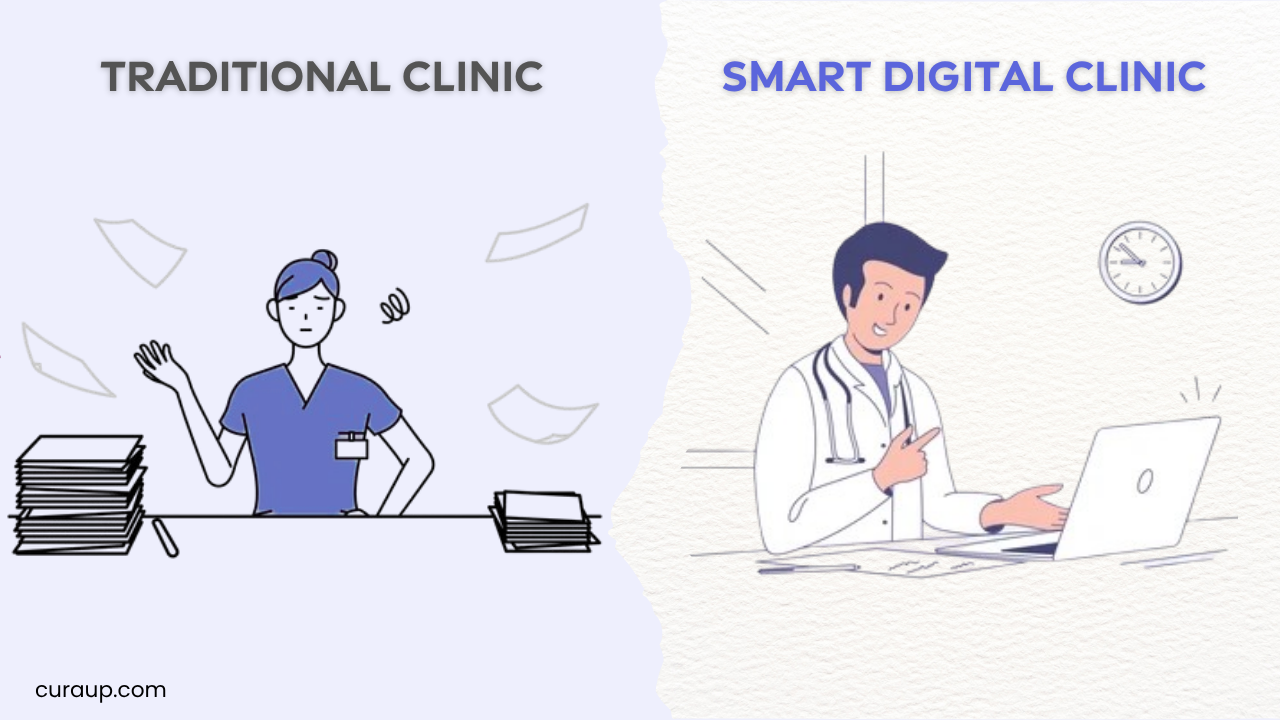
Managing a clinic with paper records can be slow and difficult. Staff spend time searching for files, updating registers, writing prescriptions, and preparing bills manually. As the number of patients increases, these tasks become more time-consuming and increase the chances of mistakes. A digital clinic workflow replaces paper records with one connected system where every department works together. Patient information is stored securely and can be accessed instantly, making healthcare faster, more organized, and more efficient.
Paper-Based Clinic Workflow
In a traditional clinic, most daily tasks are done manually.
- Appointments are written in a register.
- Patient files are stored in cabinets.
- Doctors write prescriptions by hand.
- Admissions and discharge records are maintained on paper.
- Bed availability is checked manually.
- Bills are prepared manually.
Challenges
- Takes more time
- Paper files can be lost or damaged
- Handwriting can be difficult to read
- Higher chance of mistakes
- Hard to share information between departments
Digital Clinic Workflow
A digital workflow connects every step of patient care in one system.
Appointment Management
Patients can book appointments quickly, and staff can easily reschedule or manage bookings.
Patient Visit Management
Patient records, visit history, and medical information are available instantly.
Queue Management
Patients are added to a digital queue, helping reduce waiting time and improve clinic flow.
Doctor Consultation
Doctors can view patient history, record consultation notes, and provide better treatment without searching through paper files.
Digital Prescriptions
Prescriptions are generated digitally, making them clear, professional, and easy to understand.
Admission & Bed Management
Admissions, bed allocation, patient transfers, and discharge summaries are managed digitally, improving hospital operations.
Staff & Shift Management
Staff information and work schedules are organized in one place, making shift planning easier.
Billing & Invoices
Invoices are generated automatically, reducing manual work and improving billing accuracy.
Smart Letterhead
Professional documents such as prescriptions, reports, certificates, referral letters, and discharge summaries can be created with a consistent hospital letterhead.
Paper vs Digital Workflow
| Paper Workflow | Digital Workflow |
|---|---|
| Manual appointments | Online appointment management |
| Paper patient files | Digital patient records |
| Handwritten prescriptions | Digital prescriptions |
| Manual patient queue | Smart queue management |
| Manual admission process | Digital admission management |
| Manual bed tracking | Live bed availability |
| Paper billing | Automatic invoice generation |
| Difficult record management | Easy search and access |
| More paperwork | Less paperwork |
| Higher chance of errors | Better accuracy |
Benefits of a Digital Workflow
- Saves time
- Reduce paperwork
- Improves patient experience
- Minimizes human errors
- Faster access to patient information
- Better communication between departments
- More accurate billing and reporting
- Better resource and staff management
How CuraUp Helps
CuraUp brings the entire clinic workflow into one platform. It helps healthcare providers manage appointments, patient visits, consultations, prescriptions, admissions, beds, staff, billing, and clinical documents without relying on paper records.
By digitizing everyday operations, CuraUp helps clinics work more efficiently while allowing healthcare professionals to spend more time focusing on patient care.
Conclusion
Paper-based systems have supported healthcare for many years, but they are often slow, difficult to manage, and prone to errors. A digital clinic workflow makes daily operations faster, more organized, and more reliable.
With a complete healthcare management solution like CuraUp, clinics and hospitals can simplify their processes, improve patient care, and build a more efficient healthcare system for the future.